One Stool, No Stares: How to Eat Alone in Seoul Like You Meant To
In a lot of US restaurants, asking for a table for one gets you a pity smile and a seat near the kitchen door. In Seoul, solo eating is so common it has its own word: honbap (혼밥), short for “eating alone.” Students do it between classes, office workers do it on lunch breaks, and retirees do it with a bowl of noodles and zero apologies. The city is built for groups, sure—but it is also quietly excellent at feeding one person well.
The trick is knowing where to go, what to say, and when a restaurant is actually happier with two diners. Here’s the practical version.
Learn one word and one number
Honbap is the word you’ll see on menus, blog posts, and signs outside casual spots. The number you need is han myeong (한 명), which means one person. Walk in, hold up one finger, and say “han myeong” and you’ve handled the hardest part of the interaction.
If you want to ask whether one portion is okay at a barbecue place—more on that below—try il inbun dwaeyo? (일 인분 돼요?), meaning “Is one serving possible?” If the answer is a quick nod, you’re in. If it’s a polite no, you’ve saved yourself an awkward retreat.
The three solo-dining formats that always work
Seoul has dozens of restaurant styles, but three are reliably solo-friendly without any negotiation.
1. Single-serving stew houses
Look for jjigae baekban (찌개 백반) places: a bubbling personal pot of stew, a bowl of rice, and a spread of banchan. These spots are everywhere in office districts and older neighborhoods. You order one portion, and the table fills up around you. No one expects you to share. In fact, the banchan are usually portioned for one anyway.
2. Counter noodle shops
Guksu (국수) shops—kalguksu, naengmyeon, janchi guksu—often have long wooden counters facing the kitchen. You sit, you slurp, you leave. These are some of the easiest meals in the city for a solo traveler. The menu is short, the turnover is fast, and the staff are used to people eating with one hand and scrolling with the other.
3. Barbecue places with a one-person option
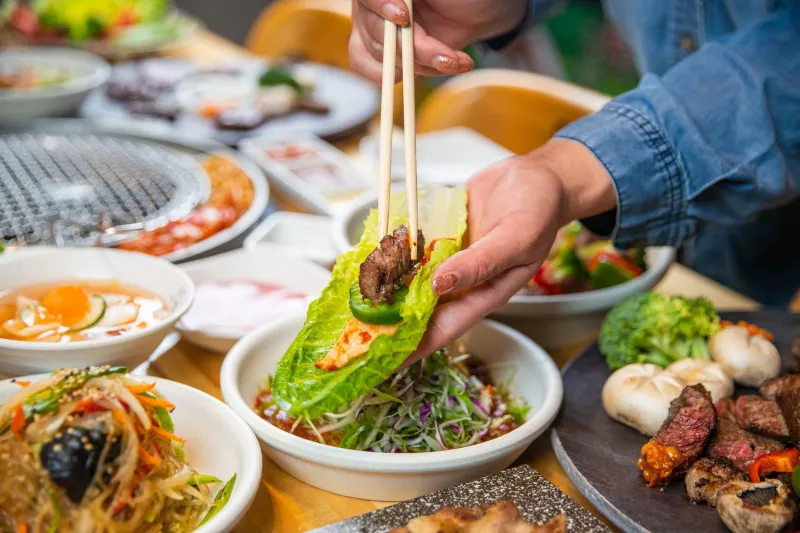
This is the one that trips people up. Korean barbecue is socially a group activity, and many grill restaurants have a two-serving minimum. But not all. Look for signs or menu notes that say 1인 가능 (one person possible) or 혼밥 가능 (solo eating possible). Some places offer a single-person set with a small grill built into the table; others will grill your meat in the kitchen and bring it out. In Hongdae and around university neighborhoods, solo barbecue is more common. In fancy Gangnam spots, less so. If you’re unsure, ask before sitting down.
How to order without freezing up
You do not need fluent Korean to eat well alone. A few phrases cover most situations:
- Igeo hana juseyo (이거 하나 주세요): “One of this, please.” Point at the menu while saying it.
- Honja wasseoyo (혼자 왔어요): “I came alone.” Useful if the host looks confused.
- Gimchi deo juseyo (김치 더 주세요): “More kimchi, please.”
- Mul juseyo (물 주세요): “Water, please.”
- Gyesanhae juseyo (계산해 주세요): “Check, please.”
At counter shops, you often order and pay at a kiosk or the register before eating. At sit-down places, you pay at the counter on your way out. Either way, no one is hovering.
Banchan refills, side dishes, and the tipping question
Banchan refills are usually free at sit-down restaurants. At some casual spots, there’s a self-serve banchan bar; at others, you flag down a staff member and ask for more. It’s normal. It’s not greedy. It’s the system.
Tipping is not expected in Korea. Not at restaurants, not at cafes, not in taxis. If you leave a few thousand won on the table, staff may assume you forgot it and chase you down the street. Rounding up is fine if you’re paying by card, but there’s no social pressure to do it. Your bill is your bill.
One more solo-specific note: at busy lunch spots, you may be asked to sit at a shared table or a counter seat. This is not a punishment. It’s just how the room works. Take the seat, eat your stew, and enjoy the fact that no one is waiting for you to finish a story.
Neighborhood-by-neighborhood, where solo eating is normal
Jongno and Insadong
Older restaurants here are full of solo lunchers. Look for gomtang (beef bone soup) and seolleongtang (ox bone soup) places—these are built around single bowls. Insadong also has plenty of dumpling and noodle shops where a party of one is unremarkable.
Euljiro and Myeongdong
Office workers eat alone here every day. Search out baekban spots—rice, soup, and a tray of banchan—or kalguksu counters. Myeongdong is touristy, but the noodle shops down the side alleys still serve plenty of solo diners.
Hongdae and Sinchon
This is ground zero for solo-friendly barbecue and cheap eats. University neighborhoods have donkkaseu (pork cutlet) shops, deopbap (rice bowls), and small grill places that will happily seat one person with a single serving of pork belly.
Seongsu and Seoul Forest
Seongsu’s cafes and casual restaurants are used to laptop workers and solo wanders. You’ll find more pasta and sandwich spots than stew houses, but the counter seating is plentiful. It’s a good neighborhood for a late solo lunch followed by a coffee crawl.
Gangnam
Business districts are surprisingly solo-friendly at lunch—just aim for the basement food courts and noodle shops rather than the tablecloth barbecue places. Look for naengmyeon (cold noodle) restaurants, which often serve single portions without a second glance.
The bottom line
Eating alone in Seoul is not a test of confidence. It’s a normal way to eat, and the city has thousands of rooms built for exactly one person with a good appetite. Learn honbap, point at what looks good, and take the counter seat. The banchan will show up either way.