Crispy, Saucy, Slightly Confusing: A Newcomer's Field Guide to Korea's Fried Chicken Chains
Fried chicken is the meal most first-time visitors end up eating in Korea — usually on night one, usually out of a foil-lined box balanced on a hotel bed — and it is also the meal most likely to go sideways. Not because the chicken is hard to like. Because the menu is a wall of Korean, the delivery apps expect a local phone number, and every chain has its own private vocabulary.
Think of this as a decoder ring. No definitive best-in-the-country rankings, no breathless superlatives. Just enough vocabulary, chain knowledge, and ordering nerve to get a crispy, correctly spiced dinner to your door at 11 p.m. on the night you land.
The Four Words That Solve Most of the Menu
Korean fried chicken menus are built from a handful of terms, then remixed with brand names.
- Huraideu (후라이드) — plain fried chicken. Crisp, salted, no sauce. The baseline.
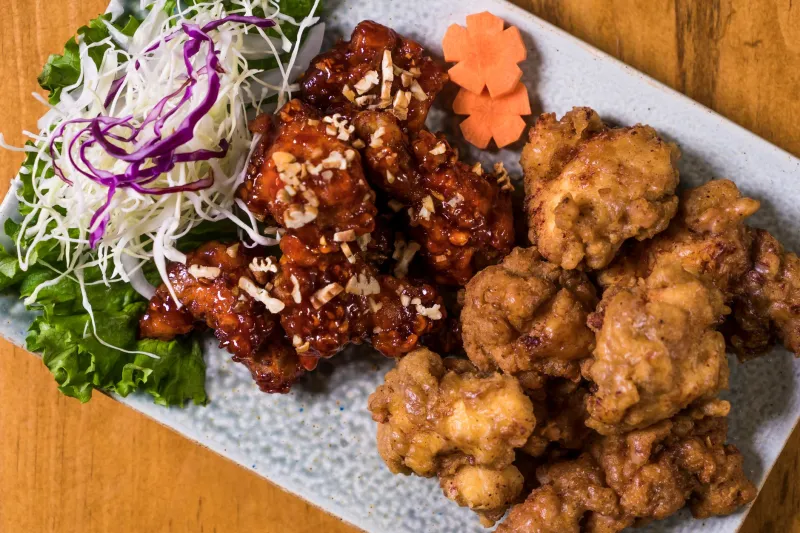
- Yangnyeom (양념) — the sticky red glaze. Sweet first, then a slow burn. This is the flavor most Americans picture when they hear Korean fried chicken.
- Ganjang (간장) — soy-garlic. Savory, glossy, barely spicy. The one picky eaters love.
- Banban (반반) — half and half. Ordering this is not indecisive; it is correct.
Two more worth memorizing: sunsal (순살) means boneless, and hanmari (한마리) means a whole chicken, which in practice arrives as eight to ten bone-in pieces. If you see maeun (매운), believe it. If you see sunhan (순한), that is the mild version.
A Chain Cheat Sheet, Sorted by Personality
Korean chains are not interchangeable, and picking the right one is half the battle.
Kyochon built its reputation on ganjang — the soy-garlic glaze here is honeyed and gentle, with almost no heat. This is arguably the safest first order in the country, and the honey-series wings make a good add-on.
BHC is where things get fun. Their Bburinkle is a dry-rubbed cheese-powder chicken served with a tangy dipping sauce. It sounds strange until you try it. Zero spice, maximum crowd-pleaser, excellent with beer.
BBQ runs the Olive Chicken line — clean, crunchy, barely sauced, dependable in every neighborhood. If you want something that tastes like very good fried chicken with a Korean accent rather than a full glaze assault, start here.
NeNe Chicken is the spice-forward option. The original is mild, but the sweet-spicy and fiery versions mean what they say. Ask for banban and pair one spicy half with a cheese-flavored half.
Pelicana is the old-school yangnyeom specialist: sticky, garlicky, a little sweet, a little aggressive. If you want the classic red-glaze experience, this is it.
Goobne is the curveball. Nothing here is deep-fried — it is oven-roasted, so the crust is thinner and the whole box sits lighter. Order it if heavy grease is not your friend, and get the galbi flavor.
Worth knowing: Bonchon exists in Korea too, but the recipes differ from the US version, so it is not the shortcut it looks like.
Boneless, Bone-In, and the Whole-Chicken Question
Bone-in gives you more flavor and a lower price per box. Boneless costs a couple thousand won more but is dramatically easier to eat in a hotel room with no plates and no knife. For a first night, order sunsal and thank yourself later.
A whole chicken runs roughly 19,000 to 25,000 won — call it $14 to $18 — and boneless usually lands in the same range. Delivery fees add 2,000 to 4,000 won. Do not tip; it is not expected here.
The Sides Are the Point
Every box should come with mu — pale cubes of pickled radish that reset your palate between bites of glaze. They are not garnish. Eat them.
Beyond that, order one thing to cut the richness: coleslaw, a cold soda, or a beer if you want the full chimaek experience. Cheese balls and rice cakes are popular add-ons when you are feeding more than two people. Chicken shops rarely send plates or utensils unless you ask, so request plastic gloves when you place the order.
Ordering Without a Korean Phone Number
This is the real bottleneck. Baemin, Coupang Eats, and Yogiyo all want local SMS verification, which a tourist SIM may not provide. Your workarounds, in order of ease:
- Walk in and order takeout. Most chains have picture menus, and pointing works fine.
- Ask the hotel front desk to call in the order. This is a completely normal request.
- Use a delivery concierge service that accepts foreign cards.
Call between 5 and 5:30 p.m. or after 9 p.m. The 6-to-8 dinner crush can mean a 60-minute wait, and nobody wants to discover that at hour one of a jet lag nap.
A Script You Can Read Off Your Phone
Say the hotel name and room number slowly, and keep it short. Most order takers will meet you halfway.
- Annyeonghaseyo, chikin jumun hago sipeoyo. — Hello, I would like to order chicken.
- Baedal ganeunghaeyo? — Do you deliver?
- [Hotel name], [room number] hoeroyo. — To [hotel], room [number].
- Huraideu ban, yangnyeom ban, sunsal-lo juseyo. — Half plain, half yangnyeom, boneless, please.
- Mu manhi juseyo. Janggab-do juseyo. — Extra radish, and gloves too.
- Eolmayeyo? Kadeu dwaeyo? — How much is it? Can I pay by card?
The Short Version
Pick one plain half and one glazed half. Go boneless on night one. Take the radish seriously. Order before the dinner rush. And if the cheese-powder chicken sounds like a gimmick, order it anyway — it is the item people text their friends about from the airport.